Showing posts with label Trail Races. Show all posts

Wednesday, April 15, 2015

10,000 Hours of Ultrarunning


10,000 HOURS OF ULTRARUNNING
AJ Cillo

I’ve been much busier than anticipated lately and, to be honest, I’ve been quite lazy about writing on here.  But, I’m feeling refreshed after my grad class ended and I finished my 2,000-word paper for work, so I’ll finally write this post.  I’ve been wanting to for a while because I’m interested in where I can go with the data.

After doing much more research about this, it appears that many people have written about running in relation to the 10,000 hours theory.  Some things were well written and made sense, some were self-indulging but offered great alleys into other topics of research.  That’s my opinion, of course.  And that’s the beauty of this blog – it’s mine and I can write what I want.  If you’ve read my posts in the past then you know that I’m critical of many people and many things, but none more than myself.  I genuinely enjoy making fun of myself, whether I’m telling the truth or making up a bunch of lies – you’ll never know.  I’m a humble person and I don’t like to be the center of attention, but on here I like to lay it all out for the reader.  I’m not hiding behind my words and I’ll gladly have these discussions in person.  But nobody ever asks.

A brief refresher about this theory.  Malcom Gladwell in his book Outliers claims that it takes about 10,000 hours of deliberate practice to master a skill, sport, trade, etc.  Reaching mastery, therefore, classifies that individual as an expert in that field.  Gladwell describes a few historical examples to illustrate his point, all of which have been used all over the internet since his book was published.  The Beatles, violin players, and chess players form the heart of his argument.  If you do a quick Loogle search about the 10,000 hours theory and spend 10 minutes reading the first few hits then you will have a decent understanding of the wave tops.  You certainly don’t need to rush over to amazon.com to buy Gladwell’s book, but I’m sure he wouldn’t mind. 

Ok.  Up front, I’ll give you my running statistics from 12 Feb 2014 to 12 Feb 2015, an entire year’s worth of running:

Number of runs:              246

Total running time:          371 hours, 41 minutes, 52 seconds

Total Distance:                  2,111.06 miles

Average Pace:                   10:34 per mile

Total Elevation Gain:       219,441 feet

Average Miles/Month:   175.92

Average Miles/Week:     40.60

Average Miles/Day:         5.78

Average Miles/Run:         8.58

Average Elevation/Run:  892 feet of gain

Average time per run:     1.51 hours


I want to break down each data set, for my own satisfaction.  Feel free to read on if you’re interested. 

The number of runs, 246, is not entirely accurate but is within +/- 5 runs.  During the summer I remember lumping together morning and afternoon runs a handful of times, then logging them as a single run.  Oh well.  This isn’t necessarily critical to the study but I wanted to point it out anyway.  Some of the runs were races, some were more like hikes, some were actual hikes, some were walks with my photographer during her (our) pregnancy, some were simple training runs, and some were meant to keep me from punching someone in the chest.  I counted them all as “runs” because they were all adding to my mileage and adding to time spent on my feet (which I’m more interested in than the mileage). 

I want to really dissect the time, distance, and elevation stats, so I will come back to them at the end.

Average pace was 10:34 per mile – not bad I suppose.  I calculated this using “running time”, meaning that when I stopped to sleep for a few hours during 3 Days at the Fair, I also stopped my running time which affected average pace.  I find this more practical than averaging my pace including stoppage time because, ultimately, I want to test the accuracy of the notion that spending 10,000 hours practicing something will make you an expert in that field/sport/hobby/etc.  If I had included stoppage time in my calculations I could probably add 30-40 hours onto my total running time, which isn’t accurate and will skew the data for this study.  In theory, I would reach 10,000 hours of running months or years sooner if I included stoppage time.  This isn’t soccer.  Or futbol.

I averaged just over 40 miles per week, based on a 365-day calendar, 12 months, and 7-day weeks.  I’m not satisfied or dissatisfied with this number – makes no difference to me.  Deep down, I wish I had trained more and harder, but who doesn’t.  I’d say 95% of those miles were focused, meaningful, purpose-related miles and only a few runs were “junk” miles simply to burn some calories so I could eat cookies later that day.  However, over the summer while I was working at Officer Candidates School, the majority of my runs and hikes were not directly focused on training for races but were scripted, prescribed events that didn’t allow for any flexibility.  Nonetheless, I counted the fartlek courses, hikes, sprint workouts, and other courses we ran towards my mileage and running time.  On the flip side, the nature of working there meant walking everywhere, at a fast pace, every day, all the time.  Thus, I probably walked or hiked 30-40 miles back and forth across the parade deck that I never accounted for because I didn’t have the time or patience to mess with my watch in front of candidates all day.  Consequently, I probably didn’t account for 7-10 hours as a result.  In the long run, this won’t tremendously affect the study and I will account for this data separately and consider it the alpha, or delta, or difference, or (whatever) of the results. 

I ran 246 times for a total of 2,111.06 miles – an average of 8.58 miles each run.  Keep in mind that I took plenty of days off but also ran multiple times on other days.  Also, my races and longer training runs skewed this number slightly.  For example, 3 Days at the Fair tallied 120 miles over a weekend, Bull Run and JFK tallied 50 miles each of those days, etc. etc.  If I consider the data without the longer runs, I most likely average between 4-6 miles during a typical training run.  Although I care more about quality than quantity, I would like to increase my miles per run this upcoming year to 6-8 miles, but that will require larger chunks of time which I probably won’t be afforded due to the workload of my next job. 

Elevation gain was a planning factor for every run.  Sometimes, I deliberately ran particular routes because of the elevation they offered.  I oftentimes ran hill repeats as well, especially in/around the I-95 corridor where the biggest hill I’ve found over the past 3 years has less than 300 feet of gain.  On average, I climbed just under 900 feet during each run.  Not bad.  Not good.  But, considering where I live and the limited options I have when compared to west coasters, I’m satisfied with that number.  I wish the number was closer to 2,000 feet, but it is what it is.  I can’t afford, nor do I have the time, to make the hour and 15 minute trip to the Shenandoah Mountains on a daily basis.  If I lived in Colorado Springs I’d have those trails memorized by the end of the first month…and I’d have long hair, a beard, and wear sunglasses to bed.  But for now, I’ll settle with being a mediocre runner at 40 miles per week and continue giving up my time to provide the warm blanket of freedom that covers my wife and son every night.

Ok, now to the meat and potatoes of this paper: distance and time spent running.  I also found a few other studies out there that were very interesting to me.  I’ll discuss all of this below.

First, a quick reminder that all of my statistics were tracked using my Garmin 310XT GPS watch.  2,111.06 miles over a period of 371 hours, 41 minutes, 52 seconds (371:41:52).  Again, average pace was 10:34 per mile and each run lasted roughly 90 minutes (1.51 hours).  My mileage averages were 5.78 per day, 40.60 per week, and 175.92 per month.  I’ve told a few people these numbers and they raised their eyebrows at me.  Some standard responses followed: “I don’t think I drove my car that far last year”, “That’s insane”, “That’s why you’re so skinny”, and “How did your knees not fall off?”  But is it really that impressive?  After doing some research, it appears that I’m still on the JV squad.

Andy Jones-Wilkins wrote an article on 22 March 2013 on the topic of running for 10,000 hours.  In it, he proclaimed the following: “But I can say, for me, this 10,000 hour rule has proven true. For the past 20 years I have run roughly 600-700 hours a year (with a few inevitable “breaks” for injuries). So, as of now, that is right around Gladwell’s magic number.”  I didn’t see any hard and fast numbers anywhere else in the article, and it’s hard to do the math with a potential delta of +/- 100 hours, but I think his numbers would look something like the data below.

I assumed that he held a pace roughly the same as I did at 10:34 per mile, and I think that’s reasonable considering he is, after all, Andy Jones-Wilkins.  Thus, he ran roughly twice as much as I did.  Let’s call it 80% more due to the 100 hour swing in his reporting.  So, taking my numbers and making them all “roughly” 80% bigger would result with this:

Roughly 600-700 hours per year (?)

Roughly 3,800 miles per year, for 20 consecutive years (How did his knees not fall off???)

Roughly 316 miles per month

Roughly 73 miles per week, every week, for over 1,000 continuous weeks…

Roughly 10.4 miles per day

These numbers are really high.  Like, roughly 80% higher than mine!  Think about this: if Andy had decided to take a day off, at an average of 10.4 miles per day, he had to run over 20 miles the next day to make up for it...for 20…straight…years…  Can you imagine what his Monday run was like if he decided to take a weekend vacation???  Obviously, there were 100 mile races in there, a lot of them.  And there were taper weeks, 50 mile races, 40 mile training runs, etc. etc.  I’m not oblivious to the training cycles and other factors that contribute to these numbers.  But, clearly, I’m not at the top of my field if other folks are putting in these kinds of numbers.  With the absence of solid data, however, can we really trust these numbers?  Are they inflated?  Who knows and who cares…  Andy’s been crushing the sport of ultrarunning for nearly longer than I’ve been alive, so I’m certainly not going to question him.  Furthermore, he got it right at the end of his article when he wrote, “And, while I don’t pretend to think that I have mastered this craft like Gates and the Beatles have mastered theirs, I can say that this is one place in my life that I have achieved a level of success and satisfaction with which I am content. And, I dare say, for a middle-aged guy putting one foot in front of the other, contentment is about as good as it gets.”  The best part is that we don’t need a GPS watch to measure his level of humility here…or maybe we do…

But did Andy peak after 10,000 hours, or did he peak earlier into his career?  Since the article was written two years ago, he should be over 11,000 hours by now.  So, does the 10,000 hours theory translate to more and more mastery in the sport of ultrarunning?  Heck no.  He was certainly faster 10 years ago than he is today, even with all the added deliberate practice.  Gladwell’s theory applies to things such as chess, playing the violin, and other things, but I don’t think ultrarunning is one of them.  Alex Hutchinson would agree (refer to his article at the bottom).  Nature vs Nurture?  (do I hear a Wedding Crashers quote?).  Are there naturals, or do all experts practice incessantly to reach mastery?  My head hurts…  Anyway, another runner named Steve Magness mentioned this in an article as well when he said, “The problem is that we've oversimplified genetics and talent. Talent has almost become a negative word. It’s often used in the context that if someone is talented they don’t work hard, as in “oh, he’s just really talented,” to explain a person’s success.”

Karl Meltzer might disagree with this, though, because he hasn’t really lost a step over the years, nor has he made any significant improvements since the early 2000’s.  He’s been at the top of the sport since the day he stepped onto the trail.  To illustrate, consider the following.  In 2011 he ran the Wasatch 100 in 20:59:53.  He ran the same race in 20:08:00 in 1998, 20:54:18 in 2002, 20:46:35 in 2003, 20:06:08 in 2004, and 20:18:58 in 2006.  This is the epitome of consistency over time.  On the flip side, he won the Massanutten Mountain 100 in 18:40:23 at 46 years old in 2014, which was an hour and 20 minutes faster than his time in 2005 at 37.  He is the ageless wonder, much like the 71-year old Gary Knipling who continues to finish 100 mile races after 23+ years of ultrarunning (his first recorded ultrarace was the Vermont 100 in 1992, according to www.ultrasignup.com). 

Going back to Steve Magness – I ran across two articles that he wrote recently.  Both are listed as (scholarly) references at the bottom of this paper.  According to Steve’s website he is the cross country coach for the University of Houston.  He also stated that he coached Nike runners for a year and a half before heading to Houston.  Unlike Andy, Steve apparently tracked and logged his runs from 01 November 2001 to 12 May 2012, right around ten and a half years.  This captured his runs from his junior year in high school until he was 27 years old.  He claimed his mileage added up to 44,000 miles during that time.  But, he explained later in his article, “Of course I didn’t have my freshman and sophomore year recorded [in high school], so it’s more like mile ~9,000 in a 48,000mi journey, but you get the point...”  He was making the claim that he reached “mastery” around mile 9,000 of the 48,000 he ran, or, as better explained in time rather than distance, around 3.5 years into his career.  Doing the math I was able to quickly convert years into hours, as the study is focused on hours based on the title of his article (“Why Gladwell’s 10,000 rule is just plain wrong”).  I assume that 9,000 miles and 3.5 years into his career equates to 1,050 hours using a 7:00 minute per mile pace.  I am also assuming that, since he arbitrarily declared that he ran 2,000 miles during each his freshman and sophomore years in high school (4,000 miles, divided by two years), I calculate that he ran a total of 48,000 miles over 12.5 years.  Thus, his numbers would look like this: (roughly, of course)

800 hours per year (?)

3,840 miles per year

320 miles per month

73.8 miles per week, every week, for 650 weeks

10.5 miles per day

These are eerily similar to Andy’s numbers.  In fact, Andy ran 10.4 miles per day, Steve ran 10.5.  Again, these are all numbers I pretty much pulled from thin air using the little bit of information they gave me in their articles.  There are numerous external factors that would affect this data such as pace per mile, stoppage time, etc.  But one thing sticks out like a hooker in church: Andy reached 10,000 hours in 20 years, Steve in 12.5 years, but the rest of their numbers are the same.  How did that happen?  Something isn’t jiving.  But, in Steve’s defense, he wrote, “Add in my freshman and sophomore year plus all the strength, biomechanics, and extra work and you’re looking at easily over 10,000 hours of training.”  So, maybe Steve’s numbers sway to the left if his total run time is 12,000 hours, or even 15,000 hours.  All of his numbers would decrease: miles per year, miles per month, miles per week, time per run, etc.  Something that only interests ultrarunners is the elevation statistic, so it isn’t surprising that he didn’t track it. 

So is this proof that Microsoft Excel works?  Did Andy drastically miscalculate how many hours he ran?  Or did Steve miscalculate the number of hours he put in?  I’m sure that Steve’s pace per mile during his 10,000 hours was nearly half what Andy’s was, which could have significant impacts on the rest of their data.  I’m not saying that my way of logging runs, using a Garmin GPS watch and Excel, is the correct way to do this study, but it sure makes sense to me.  Nonetheless, I’m still at the mercy of Garmin’s device to correctly track mileage and elevation.  It’s hard to screw up time spent running – any watch can do this.  Either way, I’d still buy some shares of Microsoft if you have some disposable income under your mattress… 

Something else I noticed while reading Steve’s articles is that he contradicted himself.  Again, that’s my opinion, of course.  The title of one of his articles is “Why ‘Gladwell’s’ 10,000 rule is just plain wrong”, which tells me he isn’t a believer in the theory.  He gave it that title because in his personal running career he peaked much earlier than 10,000 hours – around 1,050 hours.  But if you interpret the 10,000 hour theory in other ways, it clearly paid dividends.  To illustrate, consider that he is currently a college cross country coach and has coached Nike runners in the past.  Evidently, running for 10,000 hours gave him the credibility and expertise he needed to initially be placed in those positions.  But, the title of his article claims that the 10,000 hour rule is baloney.  Sure, maybe he hit his peak running performance when he was younger, but he still compiled experience and knowledge along the way to 10,000 hours.  Maybe he wasn’t an expert runner, but he certainly gained an expert reputation within the field.  If he hadn’t ran ~48,000 miles and upwards of 12,000 hours, would he be coaching college runners today?  Would he have coached Nike runners?  Hence, there is a contradiction.

In any event, I don’t have the time, energy, money, running shoe inventory, patience, iTunes playlist, or interest to sustain running 74 miles/week for 1 year – let alone 10.5 or 12.5 of them.  I have a lot of respect for Andy and Steve, and for cross country runners everywhere, because I know guys and gals are putting in 70-80 miles per week all around the country.  In the end, I still can’t fathom running that many miles on a weekly basis for 10+ years.  But one day soon, the 2-hour barrier will be broken in the marathon distance by one of those runners – it certainly won’t be one of us older guys.  It’ll be a younger runner, probably in college or a recent graduate, only 3,000-5,000 hours into his running career.  Certainly Meb isn’t going to get any faster in his old age.  I don’t foresee Ryan Hall breaking two hours.  In fact, after feeling my heart sink as I watched Ryan Hall drop from the Olympic marathon a few years ago, I don’t think much of him at all anymore.

But, a fellow named Dennis Kimetto recently ran a marathon in 2:02:57, so the human race is getting closer and closer to breaking the barrier (Todd Hargrove article).  What’s fascinating about Kimetto is that nobody has a record of him running a race prior to 2011.  Has he mysteriously reached 10,000 hours of running from his home on the other side of the world?  Has he always deliberately practiced running, or was it simply the only way to get from point A to point B?  Just four years ago he was a farmer…  I would call Kimetto a Black Swan, but that’s just me.  By the way, his 2:02:57 marathon equates to 4:41 per mile…

Moving on…  I averaged just 1.5 hours per run during the last year, for an average of 40 miles per week.  Doing quick math yet again, I would have to spend nearly 3 hours running on 246 days out of the year to reach 73 miles per week.  Albeit, that is using my average pace of 10:34 per mile.  Magness ran competitively in both high school and college, neither of which I did, and I’m sure he spent at least 3 days each week on the track, whereas I spend 0 days ever on the track.  I’m sure he put in his mileage on the track with Nike runners as well.  His pace per mile had to be in the 6:00-7:00 minute range during his 10,000 hours, maybe even sub-6:00, meaning he spent far less time running 73 miles per week than it would take me on the trails in my clunkers.

I came across many other interesting articles and writings during my research.  Some of the stuff I read was pertinent to this paper, some a little less relevant.  Here are some other things that are loosely related but still good knowledge to have. 

Maria Popova explained in her article: “Ericsson finds world-class champions – whether weight-lifters, pianists, or a dog-sled team – tend to limit arduous practice to about four hours a day.  Rest and restoring physical and mental energy get built into the training regimen.  They seek to push themselves and their bodies to the max, but not so much that their focus gets diminished in the practice session.  Optimal practice maintains optimal concentration.”  Right off the bat, it should be obvious to nearly everyone that 4 hours of running every day is not sustainable for 10,000 hours.  Again, this applies the 10,000 hour theory to only certain sports, trades, hobbies, fields, etc., and ultrarunning isn’t one of them.  It can’t be.  Running for 4 hours every day until reaching 10,000 hours would take 2,500 days, or 6.8 years.  Depending on pace, someone could easily run a marathon a day in that time, totaling mileage to an astronomical 65,500 miles over that short period.  Sure, Dean Karnazes ran across the country, did 50 marathons in 50 states in 50 days, etc., but can he run for 4 hours every day for 2,500 days?  That isn’t a dare, Dean.  Just me putting my thoughts onto paper.  In contrast to all this, if someone practiced chess, playing the violin, reading, knitting, or painting for 4 hours a day, then they might truly be an expert in their field.  This leads to more questions…

Is there a maximum heart rate tied to this?  For instance, elevating your heart rate above a certain level might take away training value to whatever it is you’re practicing.  Playing soccer for 10,000 hours might be beneficial for someone, but only if she keeps her heart rate below a certain level so that she can remain focused on improving a particular ability rather than switching into survival mode.  The fight or flight concept isn’t new, but does it apply to the 10,000 hour theory?  I’m not smart enough to answer that, but maybe someone else wants to research it…  Furthermore, practicing soccer for 10,000 hours might work if the individual can stay healthy and receive feedback.  Staying healthy is obviously essential to continued practice, but the feedback loop is essential to continued accurate practice.  It should be evident that practicing something incorrectly for 10,000 hours doesn’t mean you’re an expert.  However, it could result in being an expert idiot.  The first thing that comes to mind is something my college baseball coach once told me.  He said, “I don’t care if you put the bat between your legs and hit the ball that way, as long as you’re efficient it doesn’t matter to me.”  Hence, if I practice hitting with the bat between my legs for 10,000 hours, I might be able to rack up base hits and homeruns, but I’m going to look like a real idiot the entire time.  Then again, my coach was kind of an idiot, so take that for what it’s worth.  Or, if you don’t care what people think of you, then swing away!  That’s why I run without a shirt every chance I get.  And because my nipples chafe.

There is a YouTube documentary/series called “10,000 Hours” by a basketball player named Devin Williams.  It’s entertaining and pertinent to the study, but you won’t learn much scholarly information from it.  This was more of a shout out to Devin, who I don’t know but I’ve learned to really like simply by watching his series on YouTube. 

I found a really good definition of deliberate practice in an article, which was essentially just an excerpt from Cathy Utzschneider’s book Mastering Running.  Cathy explains, “Deliberate practice is practice aimed at reaching goals just beyond your present level of competence; it involves focusing on your weaknesses and specific needs, practicing your skills repeatedly, and continually adjusting them with feedback from a coach or teacher.”  I really like this.  It’s exactly what I always thought deliberate practice meant but I could never put it so eloquently into words. 

Cathy also wrote, “One reason it takes more than a few years to achieve one’s best result is simple: it takes that long to figure out the mix of physical and mental training habits, including strength training, patience, and race strategy that work best for you, and that mix changes over time.”  I completely agree!  However, I think the timeline to reach mastery can be shortened with good coaching, establishing good practice/training habits at the forefront, and a good feedback loop from experienced people in that field.

Cathy made another point in the little bit of her book that I read.  She wrote, “Masters runner Priscilla Welch started running at age 34 and achieved her personal best in the marathon 8 years later, at age 42, running 2:26:51 (Rodgers and Welch 1991). Older legs can be fresher legs. It took the female masters runners in my doctoral dissertation an average of 7.5 years to reach their best times, whether they started running in their teens or after age 30 (Utzschneider 2002).”  Here is a picture which helps to explain this.  I copied it from the website listed in my references.


This reminds me of Rob Krar and how he appeared from thin air to storm onto ultrarunning podiums all over the west coast.  Albeit, he was in and out of running his entire life, and at different points took years away from the sport due to surgeries.  But he was never competitive in ultrarunning before 2012.  Now he has back-to-back UROY awards above his fireplace. 

But Cathy – finally!  Someone who did legitimate research on this topic, rather than some young punk just writing aimlessly without an agenda about his annual statistics on a blog…  Thank you, Cathy.  I just bought the Kindle version of your book.

There is one last article I’d like to break down here by a gentlemen named Christopher Russell.  He wrote, “We hear a lot of new-agey talk about getting into flow states these days.  A flow state is when you’re ‘in the zone’ when everything just flows effortlessly and perfectly from you without thought or direction.”  Although I’ve never heard the term flow state, I understand the philosophy of being in the zone.  He also wrote, “In a flow state people report a feeling of confidence and well-being and peaceful bliss.  They report that time either slows down or that it speeds up to facilitate the flow state.  They know what to do without thinking about it, like an inner voice is making the decisions, the right decisions, seamlessly, every step of the way.”  I couldn’t agree more, Christopher!  During numerous longer runs or races I remember completely losing track of time, place, weather, breathing, eating and drinking.  I seemed to sort of float along the trail until something external to the sound of my shoes hitting the dirt, such as hearing another person or hearing something out of place in the woods like a plane or sirens, finally broke me from my trance-like state.  Surprisingly, I sometimes “wake up” from these episodes feeling groggy and suddenly realizing the pain.  I think Russell hit the nail on the head when he wrote, “The flow state doesn’t happen magically.  It can only be accessed through hours of practice.”

Russell also wrote two things that I went back to read a few more times so I could get a grasp on the concepts.  First, he stated, “I propose that the Zone 2 and long easy form runs are the physical practices that enables flow.  This repetition creates a physical memory that you draw from without thought.  These training runs are your 10,000 hours of practice.”  I partially agree.  The guy that runs the same 8 mile route, at the same speed, at the same time every day, is not the expert runner once he hits 3,000 hours, 5,000 hours, 10,000 hours, or even 20,000 hours.  I think the expert is the well-rounded runner who has trained outside of his/her comfort zone to determine every area for which practice is needed.  It’s the guy who reads about running, writes about running, listens to stories from other runners, and accepts criticism from others.  For example, I rarely step foot on a track, therefore I probably won’t ever be an expert runner because I probably won’t develop the fast-twitch muscles needed for speed, and I probably couldn’t hang with the local high school cross country team during their track workout.  But I read about track workouts, and I’ve done some longer training runs with high school track and cross country coaches and soaked up every word they said. 

On the other hand, someone like Steve Magness, who has spent years (although he’s the same age as me) training on the track, doing longer runs, etc., might be more qualified as an expert.  Do I think he IS an expert in the field of running?  Not really.  Do I think Andy is an expert in ultrarunning?  Not really.  But then again there’s no true way to measure whether they are or aren’t, so I can’t be wrong.  Do I think Alberto Salazar is an expert in the sport of running?  Yes.  He has years and years, and more years, of experience and being around runners of different calibers from which he draws his training programs.  I think he is more well-rounded and knowledgeable about running than anyone else, anywhere.  It’s sort of like History majors…we always want to poke fun at them while we’re in college, but now we all work for one…probably because they spent 10,000 hours reading and studying while the rest of us spent 10,000 hours partying, running, hooping…

This brings up arguably the most important and most debatable question that we should all be scrambling to answer: What defines someone as an expert runner? 

Many questions branch off from this: What is the unit of measure to determine whether or not someone is an expert runner?  Is it a question of quality or quantity, meaning the number of races won or the number of races raced?  Or is it a matter of neither quality nor quantity of racing, but of quality or quantity of coaching experiences?  Or is it simply the educated runner who has read every piece of literature, every magazine, every article, etc., but who has never won a race?  Is it the runner who has logged 100,000 lifetime miles?  200,000 lifetime miles?  Is it Scott Jurek?  Is it Dean Karnazes?  Is it Kimetto?  Does someone have to look like a runner to be considered an expert?  If so then Salazar is out.  How do we define mastery in ultrarunning?  We can take this in so many different directions that it boggles my mind.  How people define an expert runner could be drastically different than what people perceive an expert runner to actually be.  This is fundamental to the study, but I’m not about to offer a solution to this just yet.

The second thing Christopher wrote that made me physically laugh was, “You become a mystic being – a flow warrior.”  This is awesome!  I don’t agree or disagree, it’s simply just too crunchy for me…

At the end of the day, I had fun researching and writing about this theory.  Reaching 10,000 hours, for me, seems out of reach until my 50’s, which is fine.  I’ll continue logging my training and racing simply because I’m a math geek and I think Microsoft Excel is possibly the greatest invention ever.  I know my brother Alex would agree.  He’s an accountant. I’ve seen his work.  It’s well above average. 

After reading this you might be thinking, “What was his argument?”  That’s because I didn’t really make one.  It’s too early into my running career to be scientific about this stuff.  Plus, I haven’t done legitimate research.  I’ve merely read a few articles, books, and magazines.  This paper was mostly an exercise in copy-and-paste and compare-and-contrast.  I intend to continue writing about this as the years go on and I continue to work towards 10,000 hours of running.  Not because I want to reach 10,000 hours, but because I enjoy running and racing.  I still contemplate many questions, though. 

First, and most importantly, how many hours have I racked up so far?  I’ve only logged the last year and some change, but what about the previous 28 years of my life?  What about 2012 and 2013, when I raced about 10 times each year?  How many hours did I spend training for those races?  I don’t have a clue.

What counts as time spent running?  Do the times I spent chasing frisbees at the park when I was 7 years old count towards my 10,000 hours?  If so, how do I measure the amount of hours I spent running 20 years ago?  I’m certainly not going to throw a guestimate on a spreadsheet.  If I ran to the mailbox and back to get my mail, but I focused really hard on landing softly on the balls of my feet, should I add 23 seconds towards my 10,000 hours?  I might be getting a little ridiculous with this, but seriously…that all counts, right?  Before every football practice, baseball practice, and basketball practice, we would do some warm up laps around the field/court, some suicides, sprints, you name it.  Do those count?  What about the running during the practices themselves?  Does that count?  During football we were always running, but we were mostly focused on something else – carrying the ball, catching the ball, chasing the dude with the ball, etc.  So, since I wasn’t deliberately practicing running, do all those hours and hours count towards this study?  Should I consider other fitness activities towards my 10,000 hours of running, since they also increase stamina and may contribute to decreased 5k times, 10k times, etc.? 

I like where this could go and I really enjoy thinking and writing about it.  In another year, look for the dash-2 to this paper…

Feel free to comment on this post and let me know what you think.  Am I jacked up?  Did I say anything that doesn’t make any sense at all?  Don’t be afraid to tell me I’m an idiot, as long as you have some ammo to back it up. 
 

References

Alex Hutchinson.  August 22, 2013.  “On Malcolm Gladwell and ‘Naturals’.”  Runner’s World. 

http://www.runnersworld.com/general-interest/on-malcolm-gladwell-and-naturals

Andy Jones-Wilkins.  March 22, 2013.  “Running and the 10,000 Hour Rule.”  iRunFar.

http://www.irunfar.com/2013/03/running-and-the-10000-hour-rule.html

Cathy Utzschneider.  “Ten Years or 10,000 Hours to Excellence.”  Human Kinetics.  Excerpt from

Mastering Running. 

http://www.humankinetics.com/excerpts/excerpts/ten-years-or-10000-hours-to-excellence

Christopher Russell.  May 28, 2014.  “Finding Flow in your running and your 10,000 hours.”  Run Run

                Live.  http://runrunlive.com/finding-flow-in-your-running-and-your-10000-hours

Maria Popova.  “Debunking the Myth of the 10,000-Hours Rule: What It Actually Takes to Reach Genius-

Level Excellence.”  Brain Pickings.  http://www.brainpickings.org/2014/01/22/daniel-goleman-

focus-10000-hours-myth/

Steve Magness.  “The 10,000 hr rule and why talent and genes matter.”  The Science of Running. 

http://www.scienceofrunning.com/2010/07/10000hr-rule-and-why-talent-and-genes.html


Steve Magness.  “Why ‘Gladwell’s’ 10,000 rule is just plain wrong.”  The Science of Running. 

                http://www.scienceofrunning.com/2014/03/why-gladwells-10000-rule-is-just-plain.html

Todd Hargrove.  October 2, 2014.  “10,000 Hours and Marathon Records.”  Better Movement. 

http://www.bettermovement.org/2014/10000-hours-and-marathon-records/

Ultra Signup.  http://ultrasignup.com/


Thursday, January 8, 2015

Red Eye 50k Race Report

Gary, the Race Director for the Red Eye 50k last week, posted a short blurb on the VHTRC website about the race.  Here is the link: http://www.vhtrc.org/news/node/1213

Enjoy.

Sunday, November 9, 2014

03-09 Nov

03 NOV -- 1:00:03 -- 7.08 miles -- 426 elevation gain
               -- upper body weightlifting
04 NOV -- 29:33 -- 3.94 miles -- 814 elevation gain (hill sprints)
               -- stationary bike 11 miles
05 NOV -- 41:26 -- 4.73 miles -- 759 elevation gain
06 NOV -- 1:20:20 -- 9.33 miles -- 745 elevation gain
               -- upper body weightlifting
07 NOV -- 29:00 -- 2.41 miles -- 8 elevation gain (track workout, combat soccer)
08 NOV -- 4:00:55 -- 29.35 miles -- 1750 elevation gain (Rosaryville 50k, 4th overall)
09 NOV -- off -- rest

TOTAL -- 8:01:17 -- 56.84 miles -- 4502 elevation gain

Fun week!  The combination of weightlifting, hills, sprints, combat soccer, biking, and racing a 50k made this week really great.  I'm not sore and I feel awesome!  Two weeks of training remain until the JFK 50 Mile race.

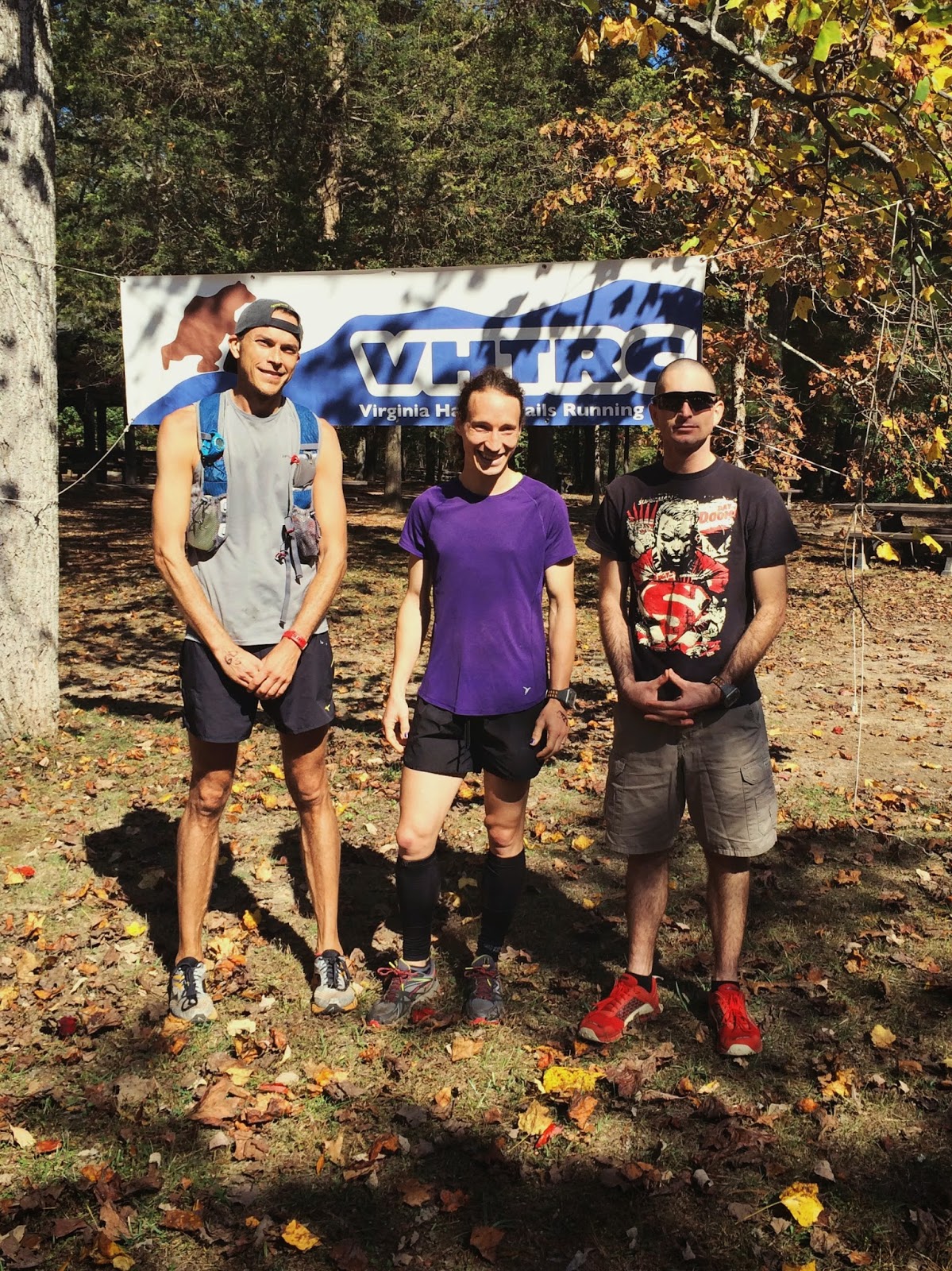
The Rosaryville 50k couldn't have gone any better.   The weather was perfect - mid-40's at the start, mid-50's at the finish, clear skies.  The trails were in great shape with only a few small dodge-able puddles from Thursday's rain.  The chow afterwards was really good (beans, rice, salsa, and tortilla chips).  Rob joined me again for this race and also ran well (5:05).  I ran a few miles with the female winner (4:20), my buddy James I met at the PB&J 50k a few weeks ago (4:10, 6th overall), and most of the last loop with Karsten (3:58) until he smoked me in the final two miles.  I finished in 4 hours flat, good for 4th overall and the coveted First Military Finisher: 


Sorry, I have only this single picture I took with my phone to send to my photographer.  LittleManCillo is still in the womb so Kar didn't participate in the 0500 wake up and subsequent 75 mile drive to the race.


Sunday, October 19, 2014

Recount #12: PB&J 50k

The inaugural PB&J 50k (aka, the Fat Lip Fun Run): a 16-mile loop in Prince William Forest Park, done twice, with aid stations at miles 6.7, 12.5, 15.5 at the turn around, 22.2, 28, and 31 at the finish.  Weather was perfect: in the mid-50's at the start, high of about 72 in the afternoon, dry trails, VHTRC atmosphere, clear skies and sunshine.


Kari and I picked up our friend Rob in the morning - this race would be his first ultra.  We arrived around 0715 for the 0800 start.  My friend Brandon also met us in the park for one loop of fun since he wasn't registered for the race.  Many other friends were there as well, either running or volunteering: Dan, Snipes, Gary (the RD), Irawan, Q, Stephanie, Jo (she made the trip from FL!), Jack, Bernard, Keith, Tom, and many other VHTRC-ers.  Here are some photos before the race:

Me and Snipes
 

Rob, me, and Brandon
 

My photographer and me
 

Irawan and me
 
Today, we celebrated a new VHTRC race with Jo (and Toni, who arrived later in the afternoon with delicious bread pudding.  I ate a pound of that stuff.)  During the pre-race brief we sang happy birthday to some folks while Q held the birthday cake.  This has become somewhat of a tradition for VHTRC races.  Well, Gary's races, anyway.  Afterwards, Gary passed some word, obviously vital to the day's activities.  Then, we hung around and drank coffee, water, or monster for another few minutes before we made our way to the start line.


It wasn't long before we started the race and took off down the road to the trail. 
 
Me, with Snipes close behind and already in visible pain?


Reaching for Kari's belly to say bye to Little Man Cillo
 
The start/finish aid station, commanded by the Commander of all troops, Kari Cillo (and Little Man)
 
I ran with some folks for the first few miles until the first aid station at mile 6.7.  Then, as always, I ended up alone in 2nd place until the turn around at mile 15.5 when I caught up with Evan.  Evan and I ran together until the next AS at mile 22.8.  After that, for some reason, my hamstrings started cramping up real bad.  I took a salt cap but 10 minutes later I started cramping again.  So, I took another one, and 10 minutes later I cramped yet again.  This continued all the way to the finish.  I think I simply got behind in my salt consumption throughout the first loop and it caught up to me on the second loop when it warmed up.  Thankfully, the trails in Prince William aren't too technical and it was only a 50k, so I didn't have too much trouble fighting through the pain.  I finished 2nd in 4:33:00.  More photos:
 
Me, breaking the imaginary tape
 

Happy to be able to run (and work on my tan)
 
Podium finishers - James (3rd), Evan (1st), me (2nd)
 
The man, the myth, the legend, Dave Snipes, finishing in prideful fashion
 

Gary hung out at the AS at mile 12.5/28 during the race where he was stung in his lower lip by a bee who tried stealing a swig of his Jim Bea...I mean, Magic Elixir.  Apparently, his lip was huge, but we didn't see him until after the race and after the swelling had subsided.  As Gary told us the story he explained, "My lip's been shrinking, like everything else on my body..."  That's the Gary we all know and love.


Snipes presented Gary with a small token of appreciation for...I don't know, for something though.  It was a coin from Silverton, Colorado that said Good For One Screw
 
Gary, Dan, Tom, and Snipes, laughing about the ridiculousness of the coin 

 Today was awesome.  Today, I'm grateful to be able to run!  I'm grateful for good friends and good company.  I'm grateful that my photographer, who is 9 months pregnant, is happy and healthy.  And, lastly, I'm grateful for the weekend!
 
 End of recount...


Monday, October 13, 2014

Recount #11: Grindstone 100

I debated whether or not I would write a recount about this race.  In the end, obviously, I decided I would.  I must admit, though, I didn’t make the decision on my own merit.  My photographer (aka my wife, for those new to this blog) caught me in a completely selfish moment and called me out on it.  If you haven’t checked the race results and haven’t read into my subtle hints thus far…I didn’t finish…  The conversation went something like this:

AJ: “Do I want to write a report for this race?  I really think I don’t.”
Kari: “Why not?”
AJ: “Well, what for?  Nobody reads it.  Plus, I didn’t finish.”
Kari: “Now, wait a second.  When you started your blog, your goal was to tell people your stories - especially your family.  And, you said ‘If I can help just one person train or plan for this race next year then I’ve succeeded.’”
AJ: “You know what – you’re right.  But that means I need to admit that I’m not Superman.”
Kari: “Yup.”
AJ: “Well, then, what am I supposed to do with my Superman underwear?”
Kari: “Throw them away, I guess.”

So, I’ve decided to put myself out there in an attempt to contribute to the ultrarunning community writ large.  It has also been brought to my attention that people do, in fact, read my stories.  I’ll get to that point later.  Although I’m deeply disappointed with myself and embarrassed that I failed, I see the importance in sharing my experience with all of you.  Likewise, I have a rather slow work week ahead of me that will provide me with plenty of time for reflection.  I’ll dive right in...

 
To start, my pacer and best friend, Tristin, who you all know from Massanutten last year, was expected to arrive Friday evening with Ryan (also came to Massanutten 2013) and Barb to crew/pace and hang out with Kari.  Well, things changed when he was struck by a vehicle while on a run back home in Pennsylvania.  He broke a few ribs and jacked up his back.  He was in a crosswalk!  Needless to say, he didn't make it, and Ryan and Barb stayed back to get him better.  Tristin is still tough as nails.  One time, I witnessed his defeat of a rabid goldfish with his bare hands.
Like most races, my photographer and I met up with Danny and Snipes beforehand for chow and story-telling.  Helen and Adam joined us for pizza and tuna sandwiches as well.  Clark gave the pre-race brief and tossed out prizes for about an hour while we watched in awe.  Helen won a pair of socks.  I didn’t win anything – looks like I didn’t get my grandfather’s lucky genes.  That guy used to win the 50-50 at every baseball game, every summer, every year.  Around 1400 the race brief ended and we parted ways until 1800, when we would convene together again behind the starting line.
Typically, races start early Saturday morning after a good night of sleep, so from 1400-1800 I really didn’t know what to do with myself.  At first, Kari and I moped around the field outside the kitchen.  Then, we walked over to Snipes’ tent and made fun of him and his 28 drop bags.  After that, I tried to take a nap on the ground next to the car.  I tossed and turned for only about 20 minutes before I was awakened by rain in the face (not to be mistaken by the Indian, ole Rain-in-the-Face). 


We weren’t camping this trip since my photographer is 8 months pregnant, so we just sat in the car and listened to music.  That lasted for about an hour until we got really bored.  If I attempt this race again I’ll need to account for the boredom factor on Friday afternoon.  Let’s fast forward to the good parts of this story…but first, a belly:


Eventually, I got too bored and started getting ready for the race around 1630:


 (all photos taken by Kari Cillo, www.kcillophotography.com)

Around 1730 Kari and I made our way towards the starting line.  Sure enough, we met up with Danny as he galloped towards us, trekking poles in hand.  We found a third friend, Ryan, and took some photos:
 
Me and Danny 
 
Ryan, me, and Danny
 
Finally, we shuffled towards the starting line.  Excitement was in the air.  So much excitement that the back half of the field didn’t hear Clark’s request for a minute of silence to remember fellow ultrarunner Maj Mike Donahue who recently died in Afghanistan.  Snipes brought some red, white, and blue parachute cord for everyone to wear during the race in his honor:
 
Cord on my pack, which I plan to keep in this location

Kari also wore some throughout the race 

My race bib
 
Ok…hat back on, shoes tightened, pack tightened, GPS calculating…3…2…1…Go!


After the race started Kari headed back to the hotel for dinner and some decent sleep.  I wouldn't see her again until the next morning.  I knew it would be a long and miserable night.  Yes!  It was already raining on and off and the temperature was going to start dropping around midnight.  Kari took this picture just after the race started and the torrential rains came upon us:


Here, I need to point out that I had never been on the Grindstone course until the race.  All I had was an elevation chart and a turn sheet.  The rule “if you can’t see the top of the hill then walk” was definitely in play for this one. 
The first mile was rough.  We took a dirt road around a small lake by the camp which funneled us into a tight corner to get onto the trail.  The bottleneck backed us up for a minute or so as the front-runners made their way through the small gap.  I was towards the middle with Danny, both of us complaining about putting our jackets on before the race started.  Once on the trail we each struggled with our packs and bottles to get our jackets off and stuffed away for later.  About 1.5 miles into the race we circled back around behind the camp where crews and families were cheering us on.  After that, the course turned dark and depressing for the next 12 hours.
I stayed with Dan until mile 2, but we were running different paces so I pushed ahead as we bid each other the best of luck.  He would finish in 25 hours and some change - congratulations, brother!
Around mile 3 it REALLY started to rain - it was then that I realized my feet wouldn't stay dry for long.  In fact, around mile 3.5 my left foot slipped on a rock going over a small stream and got wet from heel to toe.  So, to even things out, I ran through the next one and got my right foot wet too.
The strangest thing occurred around mile 4.  I mean, very weird.  I was running along the trail, looking at the ground and minding my own business, trying to get into a groove and mentally prepare myself for the awesome night ahead of me.  Usually, it doesn't require my complete attention to follow pink streamers in the trees in order to stay on course.  If a turn is coming up, it usually jumps out and bites me, especially when the trail is well-defined and the only linear feature through the woods.  So, when a reinforced squad of 25 people was suddenly running directly at me I was thrown through a loop.  I'm going to call this event the Epic Blunder of Grindstone 2014.  Chronologically, it went like this.
 
1.  A bunch of people come running at me
2.  I ask, "Where are y'all going?"
3.  They proclaim that they missed a turn and haven't seen a streamer in over a half mile
4.  All but 2 of the runners in that group start running backwards on the course to look for a streamer
5.  About another 50 runners behind us all stop in the middle of the trail and assume they are also lost
6.  There are now about 100 people standing in the middle of the trail, apparently lost
7.  Someone sends a runner backwards on the course to look for a streamer
8.  Meanwhile, I stand in one spot and stare in amazement for about 15 seconds
9.  After 15 seconds, I realize there was no way that 100 of us missed a turn, so I continue running
10.  Just then, someone behind me yells, "We found it!" and everyone starts back down the trail
11.  About 4 people scurry to get back in front of me, so I move over and let them pass
12.  Everyone is now running in the same direction, towards the finish, as a group of 100
 
It was surreal and I've never experienced anything like it.  Hilarious!  The first aid station was at mile 5-ish and I ran through it in 22nd place.  I quickly calculated that I somehow got in front of about 50-ish people as a result of the Epic Blunder of Grindstone 2014.  Unreal.
Around mile 4.5 I found myself running alone with someone I didn't know.  After a few minutes I broke the silence:
 
Me: "So, what's your name?"
Megan: "Megan.  What's yours?"
Me: "AJ.  Nice to meet ya."
Megan: "Are you the AJ that ultra-writes?"
 
I had never heard the term "ultra-write" before, and it caught me by surprise, so I didn't know what to say other than...
 
Me: "......Huh?" 
Great first impression, bimbo...
Megan: "Do you write about your races online?"
Me: "Ohhhh.  Yes, I do that..."
nervous and embarrassing laughter
Megan: "Cool.  I follow your blog."
Me: "Really?  Wow!  You're the first person I've met, other than family or friends, that actually reads it.  Thank you!" 
 
 
Holy smokes - people DO read my blog!  I suddenly felt relieved knowing that other ultrarunners read my stories.  Once I launch a race recount on here I don't really follow up on the number of hits, where it was posted, who left comments, etc.  But I secretly think it's really cool that accomplished runners like Megan, who has been victorious at all distances including 100 miles, take the time to read what little AJ has to say.  Megan finished 2nd female overall in this race - congrats, Megan!  And thanks, everyone!  I will continue writing recounts of my trail experiences.
Megan and I ran together through the first aid station and up a portion of the hill that followed.  At some point, I don't remember where or when, I got ahead of her and found myself walking the mountain alone.  Unfortunately, I would be alone the remainder of the night until the sun came up on Saturday when I raised the white flag.
Miles 6-10 were difficult.  The course winded up a mountain for about 3,000 feet during those couple of miles.  Although I had never been on the course, I picked the brain of the great Dave Snipes to determine where/when to walk and where/when to knock out 10:00 minute miles.  Thus, I knew I would be walking this portion of the course.  What made things difficult, however, was the fog.  Oh, the fog.  Words can't explain how bad it was on the ridgeline.  In fact, the fog deserves its own paragraph in this recount.
The definition of fog is ,"a cloudlike mass or layer of minute water droplets or ice crystals near the surface of the earth, appreciably reducing visibility" (Dictionary.com, search parameters "fog", retrieved October 12, 2014 from http://dictionary.reference.com/browse/fog?s=t).  If Grindstone could define fog it would probably be, "a wall of white clouds, exceptional at nullifying headlamps and flashlights during periods of darkness, efficient at concealing navigational streamers and trailways" (My brain, search parameters "the gosh darn fog", retrieved October 12, 2014 from mybrain.crappyraces.fail).  The fog worsened as we climbed higher and higher.  Around mile 7 the trail dumped us onto a service road for the next 2 miles to the top.  I didn't think it could get any worse, but sure enough the fog steadily thickened more and more from miles 7-9.  Just below the summit, I legitimately walked right off the service road multiple times.  I couldn't even see my feet at one point.  I tried dimming my head lamp, brightening my head lamp, walking in the dark, taking my head lamp off and holding it by my feet...nothing worked.  Clearly, if I couldn't see my feet then I couldn't see pink streamers in the trees anymore.  Luckily, there was only one turn off the road and it was well-marked.  Finally, I reached the top, punched my bib with the stamp to prove I was there, then ran away real fast.  I don't have any good pictures of the fog that night, but it would probably look something like this:
 
Courtesy of google, pretty sure it's the Golden Gate Bridge
 
The course took us down the backside of the mountain from miles 10-14, so I was able to gain some time back from the 17:00 minute miles climbing the front side.  I kept thinking, "what goes up, must go back down."  I tell myself this all the time during out-and-back ultras - it helps me come to peace with monster climbs knowing that I get to run back down on the way back.
I linked up with a guy named Ryan for a mile or so during this stretch.  He had long hair, dreadlocks.  I've always liked dreadlocks.  If I could, I would grow dreadlocks.  The Marine Corps should permit dreadlocks.  We griped and moaned about the rain, fog, and the hills.  He stopped to tie his shoe and I kept running.  I didn't catch his last name but I checked the results and every guy named Ryan finished the race.  So, congratulations Ryan!
I ran into the aid station at mile 14 by myself.  There were two other guys eating some chow and filling their bottles when I got there.  This AS was operated by Clark's students - about 6 of them.  I shoved a few pieces of PB&J into my mouth, grabbed a few for the road, and headed off leaving the other two runners behind.
Right after I left the AS I turned on my music for the first time.  I wanted to wait until the field spread out - I don't ever want to be that guy, the guy who doesn't move over for someone to pass because his music is too loud.  There were some hills over the next 8 miles - some went up and some went down.  Overall, there was about 2,000 feet of elevation gain until mile 22. Again, I was alone this entire section, so I was able to get into a groove and zone out with the music.  Lots of Michael Franti who, ironically, has dreadlocks.  Some older songs from the Goo Goo Dolls, Ludacris, Juvenile, Green Day and Blink 182.  I saw Green Day and Blink 182 in a concert at Hershey Park in 2002 - insane!  And, of course, "Love Shack" was placed on repeat for a few miles during times of heavy rain and high winds (which I'll speak to shortly, well, right now I suppose).
From miles 14-22 the wind started to pick up but the rain subsided at times.  As the weatherman might put it: tonight you can expect periods of rain with winds 10-15 mph coming out of the west, heavy fog at times so watch out for those deer, humidity will hover near 80% until temperatures start to dip into the lower 50's around 3am, by sunrise expect the rain and fog to clear up and temps in the upper 40's.  It was chilly along the ridge, but my jacket remained in my pack until later on.  This stretch went by pretty quick and I was alone the entire time.  I strolled into the AS at mile 22 where I found a ton of people!  Since I didn't have a crew until the next morning when Kari would meet me at mile 65.65, I didn't pay much attention to aid stations prior to that.  Families and crews lined the service road into this AS for about 100 yards.  Like the last AS, I ran by a few runners with their crews as I headed into the tent to get some chow and refill my pack with cold water.  Just as I shoved a PB&J into my mouth, my friend Megan McGrath came up and gave me a good luck hug in the absence of my photographer.  She was crewing/pacing another friend and was waiting for him to arrive.  She asked how I was doing, ensured I was keeping up with my salt, then sent me on my way.  It was refreshing to see someone I knew after running alone for so long. 
Miles 22-30 were interesting and fun.  I left the AS at mile 22 and started walking up a mountain.  There were about 10 of us, all equally spread out.  I could see headlamps both in front of and behind me in a Congo line.  We all jostled for position over the next 8 miles.  One guy, Matt, stopped on the side of the trail to rearrange some gear, so 3 of us passed him.  Not 10 minutes later he came roaring down the trail behind us, "Passing on the left.  Passing on the left.  Passing on the left." as he knocked us off one-by-one.  Sure enough, about 20 minutes later, I passed him again.  We all did this for 8 miles.  In the end, I somehow rolled into the AS at mile 30 by myself again, but ahead of that pack of runners.
The AS there lit up the entire treeline.  Not very tactical, but they had pickles!  As I shoved a few into my mouth I explained to the AS crew that my wife had been stocking the refrigerator at home with pickles for the past 3 months (ya know, cravings).  I took a quick shot of Coca-Cola and headed off into the darkness for the next 6-mile stretch to mile 36.  As I walked away I blurted out, "Real quick - do y'all know how many are in front of me?"  Some guy yelled back, "Seventeen!"  "Sweet, thank you guys.  Thanks for being out here in the cold and rain all night!"  Wow - I was in 18th.  I mumbled to myself, "I might be going too fast."  Like most races, I wasn't keeping tabs on what place I was in, but it's always good to have a reference point to work with.  I was averaging 12:00 minute miles and felt like I was holding back, so I didn't make any drastic changes to my pace and simply kept on pushing.
The next 6 miles were fun and offered lots of downhill running.  Typically, I start to feel really good after mile 30, which held true for this race as well.  This section was fairly technical, though, and I knew there was lots of running to go.  So, I continued to walk up the hills, but I started crushing the downhill sections hard.  I also knew there was a killer climb from miles 36-43 and that I would be walking nearly all of it, along with everyone else, so I didn't hold back on the downhill sections here.  In fact, I knocked off a few 10:00 minute miles and even passed a few runners.  I linked up with Keith K. just before the AS and ran in the last half-mile with him.  We entered the AS in 11th and 12th places, respectively.  ("Sweeeeeeeeeet! Level twoooooooo!")  We took turns on the scale and grabbed some eats for the road.  At the start, I weighed in at 146 pounds.  Here, 144 pounds.  Only down two pounds - not bad after 36 miles.  The clementines were exceptionally tasty at this AS, so I ate a few and took a few for the climb.  I also helped myself to two pierogies - mmm mmm good!  I quickly headed to my drop bag, replenished my Gu gels and Honey Stinger chews, and started hiking.  The next 7 miles were straight uphill - literally, straight uphill, 3,200 feet uphill.
Keith and I were walking together initially, but he was saving energy for later so I pressed ahead.  Again, I was alone...again...the entire climb....which felt like it would never end.  It was at this point that I realized Grindstone isn't necessarily difficult - it's dark with lots of hills, but it isn't too technical and most of the course is what we call runnable.  However, the section from miles 36-44 and, subsequently, miles 57-65.65, is VERY difficult.  Climbing that mountain temporarily broke me.  About 95% of those miles were uphill.  Only a few short sections were runnable, but I walked most of those anyway to give my quads a break.  By the time I reached the top I was broken and depressed.  I had averaged only 16:00 minute miles climbing that dang mountain, with my slowest at 20:17 and my fastest at 10:52.  What made it worse was that I thought the AS was at the top, but I had to run another mile and a half down a service road and through a couple fields to get to it.  And, as if things were bad enough, the fog had returned and was thicker than ever along the ridgeline.  And, even worse yet, the wind was howling and my jacket still resided in my pack.  And, just when things couldn't go any wronger, yes wronger, my headlamp ran out of juice.  I was in a bad place. 
Finally, after a miserable section, I reached the AS at mile 44.  I managed to stretch out the life of my headlamp until the AS by dumb luck - I was walking and taking off my pack to scrounge together some batteries as I saw the lights ahead of me.  Thankfully, one of the volunteers at the AS offered to change the batteries for me while I ate more pierogies.  But not so thankfully, it took him 5 minutes to do so.  This is where things went south in a hurry and I had my first scare of the race.  It was raining all night and I hadn't put my jacket on yet, so I was soaked.  The wind was howling.  Wet is ok, wind is ok, but wet and wind together is not ok.  I started shivering bad - teeth chattering, knees shaking, brrrrrrrr.  Then, my hip flexors starting cramping up.  And then my hamstrings got achy.  I jammed two salt tabs down my throat with some water.  Then, I elected to finally put on my jacket just as he finished assembling my headlamp.  That $5 Nike Golf jacket from TJ Maxx, which I introduced to you all during my JFK 50 Mile race recount from last year, is what saved my race.  Well, saved me from dropping at mile 44, at least.  I zipped it all the way to my neck and took off in a sprint to get my body warmed up again. 
The next 5 miles were along the ridgeline on service roads - a nice break from walking up steep inclines.  I started feeling better once I got moving and got blood flowing through my body again.  I kept my pace between 11:00 and 12:00 minute miles through this section.  Around mile 47 the lead runners started passing me in the other direction, about 7 miles ahead of me.  First was Jeff Browning, running solo.  Man, he's hard.  Next was Brian Rusiecki, about 10 minutes behind, just as I rolled into the AS at mile 49.  Here, we had to make a quick detour to the summit of the nearby mountain - only half a mile up, punch our bibs with the stamp, then half a mile back down to the AS, all on concrete.  I ran right through it on the way up to the lookout, but on the way back down I stopped for some chow - dark chocolate, PB&J, and some ginger ale.  It was only 2 miles to the turn-around at mile 51, also on concrete.  I grabbed half a S'mores Pop-Tart and headed off down the road.
Immediately, 5 or 6 runners passed me in the other direction, which meant they were about 4 miles ahead of me.  I kept to myself with my head down and pushed on.  It was mostly downhill until the turn around and I kept my pace around 10:00 minute miles all the way there.  Strangely, the AS at mile 51 was the first one with oranges.  I ate probably 3 full oranges while the volunteers filled my pack with water.  Nearby, a group of 4-5 kids, probably 12 years old or so, were sitting in lawn chairs by a fire roasting marshmallows.  I was about 10 hours and 30 minutes into the race, so it was 0430-ish in the morning.  I asked why they weren't making S'mores and they told me they ran out of chocolate, which was probably the reason they were still awake!  I stood by the fire and joked with them until my pack was full.  I grabbed a few pickles and some more oranges, thanked the volunteers, and started the journey backwards...
"What goes up, must go back down."  Also, "what goes down, must go back up."
Those downhills miles were nice from 49-51, but going back up was uncomfortable.  I shuffled most of it but there were some places steep enough to warrant walking, so I gave in and walked.  My splits were in the mid-13:00 minutes, which I was fine with.  One runner passed me heading towards the turn around and say "Good job, man!"  Sometimes I forget where I am, and for some reason I blurted "Errah!" as if acting obnoxiously amongst fellow Marines.  Oops.  Well, maybe that motivated him.  I'll never know. 
I got back into the AS at mile 53, also mile 49, and grabbed more dark chocolate.  The AS Captain here was wearing camouflage overalls with a camouflage hat.  Righteous.  He offered me a fresh PB&J, and who doesn't want a fresh, soft, delicious PB&J?  I took it for the road.  After one bite I realized the bread was crusty.  It had definitely been sitting out for a few hours.  Maybe he grabbed from the wrong pile.  I tossed it into the woods for the rabbits. 
At this point, runners were passing me going the other direction every minute or so.  I tried to ID each person to see if I knew them, but it's difficult with headlamps because we blind each other in the process.  Therefore, I defaulted to yelling "All right, all right!  Good job!" to each person.  But then, someone ID'd me - it was Danny! 
 
Danny: "Wooooooo!  All right, AJJJJJJJJJJ!  Great job, man!"
Me: "Dannnnnnnnnnyyyyy!  Looking good, mmbannnn...bannn...mannn..."
What the f---?
 
It was then that I realized something was going wrong.  I was around mile 55, heading to the AS at mile 57 before that monster 3,000-foot downhill.  I started thinking what could be happening - was I overheating?  Nah.  Was my face frozen?  Heck no, it was only 50 degrees.  Well, what the heck?  I was confused.  I noticed I started getting tunnel vision a few miles earlier, which is normal after looking through the cone of a headlamp for so many hours.  But it didn't occur to me until I was forced to think and act quickly that I was very tired.  So tired, in fact, that I began to hallucinate after seeing Danny.  My brain was motoring, 100 miles per hour.  Meanwhile, runners kept running towards me, passing me going the other direction at a steady clip of 1 every minute.  Holy smokes - what is going on?  I tried shaking my head side to side - no luck.  I tried slowing down - no change.  I tried dimming my headlamp - I couldn't see the ground anymore, duh.  I tried sprinting - sheesh, too tired for that.  I took an Endurolyte thinking it might help in some medically unfathomable manner - negative.  Below is my attempt to verbally describe what I was experiencing, which lasted all the way to mile 65.65 where I subsequently called it quits:
 
- "Dannnnnnnnnnyyyyy!  Looking good, mmbannnn...bannn...mannn..."
- Woah, something is wrong with my mouth, my lips won't move how I want them to move
- Oh shoot, the ground looks really close, like I can touch it right now
- Ok, more headlamps coming towards me
- Hey, there's a runner right in front of me now, "Hey Matt..."
- That definitely wasn't Matt, he's in Quantico right now, he's not even an ultrarunner
- Oh man, why did I think that was Matt?
- Another runner is coming towards me, "Hey Matt..."
- Shit, that wasn't Matt, he isn't here
- Woahhhhh!!!  Turtles!!!  All over the trail!!!
- I gotta dodge all these turtles, so I'll just hop right over them
- Another runner, "All right, all right!  Good job, man!"
- That was a girl...
- Wait, maybe it was Matt
- Oh yeah, he isn't out here, we just discussed that
- But Matt should be out here!  Yes, he should certainly be out here
- I bet Matt is connected to these turtles somehow
- Matt is like a ninja
- Ohhhh, ok, I get it, these must be ninja turtles
- Gotta keep hopping over these ninja turtles
- Oh, thank goodness, there's the aid station, I'll pick up the pace (laughing out loud, literally, as if I just uncovered a dirty little secret)
- Man, that aid station isn't getting any closer
- Darnit, those were city lights in the distance, not the aid station
- There's another runner, "Hey Matt..."
- Oh shit, I'm just gonna stop talking
- Another runner coming
- Crap, he said "good job" but I didn't say anything back
- It's all good, it was just Matt, I'll see him on Monday and apologize
- Ok, there's a bright light ahead, that has to be the aid station
- Hey, look, there's a sign that says it's the aid station, this must be the aid station
 
That was just from miles 55-57.  That would continue after the AS, all the way down the hill, and into the next AS at mile 65.65.  Along that section of 7-ish miles, I ran across VHTRC Ambassador Gary K., the padre of Keith K., just as the sun came up.  He was climbing the mountain, still at mile 39-ish.  What a stud.  Basically, he's a freak of nature.  He finished the race in 35 hours and 29 minutes after running through the night...both Friday and Saturday nights!  He's also 70 years old.  And a freak.  And a stud.  His legs are made from the horns of 27 unicorns.
After 60 miles and 12,000 feet of elevation gain/loss, it starts to hurt running downhill more than it does uphill.  Dropping 3,000 feet over 7 miles really hurt my quads.  I was able to maintain 13:00-14:00 minute miles, which isn't impressive to anyone, but it was better than 20:00 minute miles.  But I was getting really sleepy - more sleepy than I was even after finishing Massanutten 100 after running for 25 straight hours.  And the hallucinations didn't end when the sun came up.  Shortly after I saw Gary, I stopped and started to lie down on the side of the trail.  I got down on one knee, then the other, then lowered my right hand towards some grass and started leaning my head towards the ground...
 
Thoughts to myself:
 
Wait, huh???  I can't take a flipping nap right here.  Dang, dude, I gotta get to that aid station.  I know I'm close - I remember that rock.
 
A few minutes later I started running across little wooden bridges.  That's when I knew I was nearly there.  A few minutes later I started hearing people talking.  Then the trail turned and I was looking straight down the barrel of a Cannon 60D:


The AS at mile 65.65 had Clementines!


When I first arrived, I gave Kari and her belly a kiss and made sure she was feeling alright.  She was a little tired and didn't sleep well in a new bed.  Plus, I forced her out of bed around 0600 to come aid me in my quest. 
I fully intended on continuing with the race.  I grabbed the remainder of my Gu Gels from my drop bag and replaced them with empty rappers in my pack.  Kari put some more salt tabs in my Ziploc then put it back in my pack as well.  I asked her if she had any Ensure with her, but she left it in the car.  So, she took off running to the car and I yelled out, "Bring two!"  I helped myself to 3 pierogies, a few Clementines, and some M&Ms while I waited.  When she got back I downed both bottles of Ensure.  I asked if she had more, so she ran back to the car again to get more.  I was feeling ok at that point.  I still hadn't weighed in so I headed over to the scale - 140 pounds, even after the Ensure and chow.  Not good.  Down at least 6 pounds since the start.  I shoved another pierogie in my mouth and started preparing mentally for the next 6-mile stretch.
Just then, my eyes shut.  I was standing up, eating food, talking to my photographer, and my eyes closed.  My knees buckled and I swayed to the side.  Yikes - I just fell asleep standing up.  I've been awake for 3 days straight before during long operations in the desert, and I ran through Massanutten without sitting down even once, so this was a surprise.  Kari looked scared when I opened my eyes.
 
Kari: "Did you just fall asleep???"
Me: "Yeah.  I've been hallucinating for the past 10 miles or so as well."
Kari: "Are you ok?"
Me: "I don't know yet.  I'm seeing stars."
 
I couldn't believe how quickly I went from having one foot out of the aid station and on the trail, to falling asleep standing up and hallucinating again.  Again, Kari tried to ask me if I was doing ok, but I fell asleep again and almost fell over.  We repeated this a few times until she got angry and starting pushing me towards the trail.  I was prepared to keep running, but I wanted to take some chow for the road.  But as I walked over to grab a PB&J I fell asleep walking.  I also thought I saw a jar of pickles on the table but there were no pickles.  I stopped and leaned my head on Kari's shoulder to take a break for a second and, as expected, fell asleep standing up again.
 
Me: "Kar, I don't think I can stay awake right now."
Kari: "You need to.  What do you need before you leave?"
Me: "No, really, I cannot stay awake.  And I keep seeing shit."
Kari: "No.  No.  You're finishing this race."
Me: "Dude, I really can't stay awa........"  (again, sleeping while standing, eyes closed and all)
 
In hindsight, I should have taken a quick nap or found some coffee or something.  I tried jumping around and smacking my legs to wake back up, but every time I stopped moving for even a second I fell asleep standing up.  And then, I started shivering again.  Teeth chattering, legs quivering, brrrrrrr.  Now, I was falling sleep standing up while shivering.  Things were going south quick.  I knew I either needed to get running again, or drop.  Taking a nap wasn't an option at the time, for whatever reason, although it was probably the most sensible plan.  After some more debating with Kari, who was genuinely scared and upset and emotional, I decided to pull myself from the race.  I knew the next 6 miles were mostly uphill with roughly 2,000 feet of climbing, and I kept doubting my ability to remain awake on the run.  I was in a rut like never before.  I had a deeply regretful moment of fear and weakness and told Kari to tell the AS volunteers that I was done.  Certainly, I could have taken a nap for a few hours and still finished the race.  I was on pace to finish in roughly 21 hours and I had plenty of time to waste.  But my head wasn't right and I completely rejected stopping unless I was stopping for good.  During ultras, something always tells me that I cannot take a break.  I take pride in the fact that I have NEVER sat down during a race.  However, dropping from yet another race is painful... 
While Kari grabbed her things I stood by the AS tent with a blanket wrapped around me to stay warm.  Pathetic little weakling...  Apparently, I legitimately fell asleep standing up because a woman tapped me on the shoulder and told me I should sit down in her chair. 
Getting to the car was difficult.  My legs were cramping everywhere because I kept shivering.  I was falling asleep every 5 seconds - at the back of the car, at the front of the car, standing with my shirt off, sitting down in the middle of the road, leaning against the car, everywhere.  I struggled hard to stay coherent enough to change  my shirt and sit down in the front seat.  Once I got there, I zonked out hard until we got to the hotel.  When I woke up, I still wasn't with it and had no idea where I was.  God bless my wife - she dragged me out of the car, got my bags, and got me into the hotel room where I immediately fell asleep sitting on the grungy floor.  These shenanigans continued until 1500 that afternoon.  After a shower and a long nap, I was finally able to hold a conversation with Kari for more than 30 seconds. 
Trying to run Grindstone is tough after a full work week...
Ok, I think I've shamed myself enough.  This blog needs to come to an end eventually, but not before I share some pictures of the awesome food that the small town of Staunton offers:
 
Sulking before getting pizza for dinner


This stuff was legit 
 
 3 scoops for me
 
 2 scoops for my photographer
 
Still angry with myself, but how can I be upset with ice cream in my hand
 
End of recount...